Наші мандри › Форуми › Bread Journeys › How to Bake Sourdough Bread in a Cold Kitchen: Recipe and Fermentation Times
- This topic is empty.
-
АвторЗаписи
-
-
24.11.2026 о 16:57 #15913
Can you bake great sourdough bread in a cold kitchen when the room temperature is only 16–18°C (61–64°F)? Absolutely. You don’t necessarily need a proofing box, special equipment or a constantly heated kitchen. Understanding fermentation and giving your dough enough time can make all the difference.
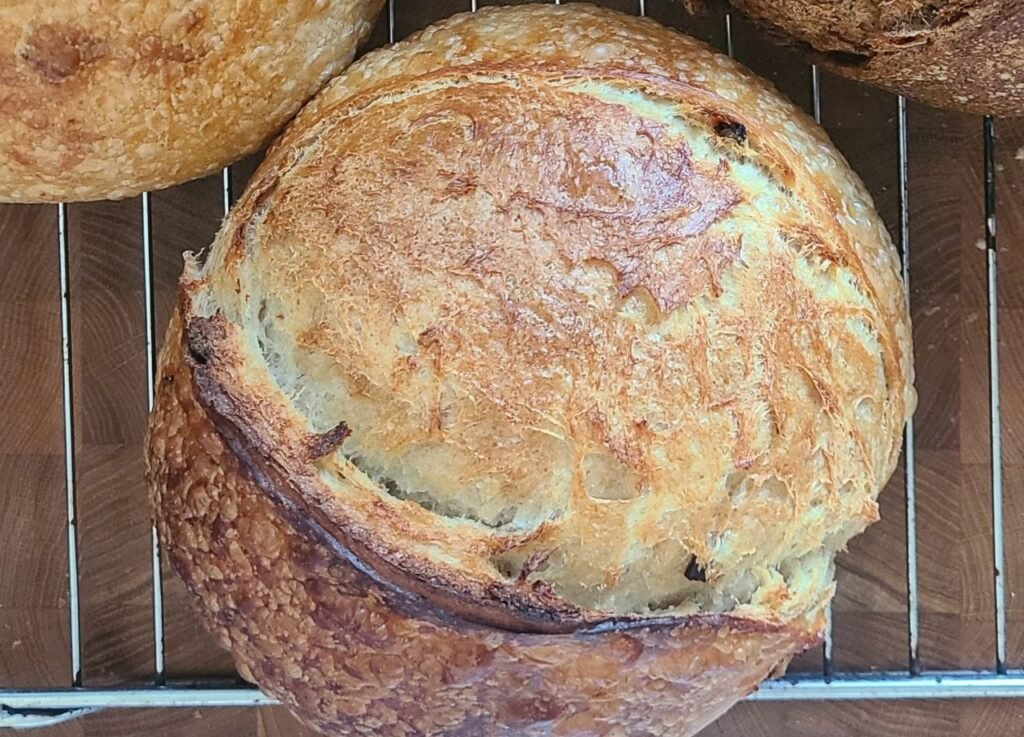
Homemade sourdough bread fermented in a cold kitchen at 16–18°C (61–64°F). Living in Ukraine, where electricity and heating interruptions can make indoor temperatures unpredictable, I’ve had plenty of opportunities to experiment with sourdough baking in cooler conditions.
Recently, the temperature in my apartment has been fluctuating between 16 and 20°C (61–68°F). While this makes fermentation slower, it certainly doesn’t mean I have to stop baking bread.
Here is my experience, the recipe I used and the fermentation schedule that worked for me.
My Sourdough Bread Recipe for a Cold Kitchen
For this bake, I used strong bread flour with a small amount of whole wheat flour. Strong flour helps the dough maintain its structure throughout a long fermentation.
Ingredients:
- Strong bread flour: 460 g
- Whole wheat flour: 40 g
- Water: 325 g
- Active sourdough starter (100% hydration): 120 g
- Honey: 15 g
- Salt: 10 g
- Butter: 10 g
My wheat sourdough starter was fed with equal quantities of flour and water by weight and was active when I added it to the dough.
Including the flour and water contained in the starter, the dough hydration was approximately 69%.
This is a manageable hydration level for many strong bread flours, although water absorption can vary considerably between different brands.
Mixing the Dough and Bulk Fermentation
I started with a one-hour autolyse, mixing the flour and water and allowing them to rest before adding the other ingredients.
After an hour, I incorporated the active sourdough starter, followed by the salt, honey and butter. Each ingredient was added separately.
During the first two hours of bulk fermentation, I performed four sets of stretch and folds, approximately 30 minutes apart.
These folds helped strengthen the dough and improve its ability to retain the gases produced during fermentation.
After the final fold, I simply left the dough alone.
At a room temperature of 16–18°C (61–64°F), my bulk fermentation lasted approximately nine hours, measured from the moment I added the starter.
Once the dough was ready, I pre-shaped it and allowed it to rest on the counter for about 20 minutes before final shaping.
I then transferred the shaped dough into proofing baskets and placed them in the refrigerator at 4°C (39°F) for another 11 hours.
The bread was baked the following day, and I was very pleased with the result.
My Cold Kitchen Sourdough Fermentation Schedule
Stage Duration Autolyse 1 hour Bulk fermentation 9 hours Stretch and folds 4 sets during the first 2 hours of bulk fermentation Bench rest after pre-shaping 20 minutes Overnight cold proof 11 hours Baking The following day The stretch and folds are included in the nine-hour bulk fermentation period, not added to it.
This schedule reflects my actual baking experience rather than a universal timetable.
How I Baked the Sourdough Bread
After 11 hours of cold proofing in the refrigerator, the dough was ready to bake. I used a Dutch oven with a lid to retain steam during the first 30 minutes of baking.
I preheated my oven to 250°C (482°F) and followed this baking schedule:
- 10 minutes at 250°C (482°F) with the lid on.
- 20 minutes at 220°C (428°F) with the lid on.
- 15 minutes at 220°C (428°F) with the lid off.
The total baking time was 45 minutes.
Keeping the lid on during the first stage of baking helps retain moisture, allowing the dough to expand before the crust sets. Removing the lid during the final 15 minutes allows the crust to develop its colour and crispness.
After baking, allow the bread to cool completely on a wire rack before slicing.
Why Does Sourdough Ferment More Slowly in a Cold Kitchen?
A sourdough starter contains wild yeasts and lactic acid bacteria. Together, these microorganisms are responsible for the fermentation, flavour and characteristic aroma of sourdough bread.
Many sourdough recipes are designed around a dough temperature of approximately 24–26°C (75–79°F).
In a colder environment, microbial activity generally slows down, meaning the dough needs more time to develop.
However, there is an important distinction between room temperature and dough temperature.
Even if your kitchen is only 18°C (64°F), your dough may initially be warmer, especially if you use slightly warm water or a stand mixer.
Over time, the dough temperature gradually approaches the temperature of its surroundings.
This is why two bakers working in kitchens with identical room temperatures may experience different fermentation times.
How Long Should Bulk Fermentation Take in a Cold Kitchen?
In my experiment, nine hours of bulk fermentation at a room temperature of 16–18°C was sufficient.
However, I wouldn’t recommend following nine hours as a fixed rule.
Several factors affect fermentation speed:
- Starter activity
- Dough temperature after mixing
- The amount of starter in the recipe
- Flour characteristics
- Dough hydration
- Room temperature
Rather than relying entirely on the clock, pay attention to the dough itself.
Look for a gradual increase in volume, visible gas bubbles, a more aerated structure and a slight wobble when you gently move the fermentation container.
The dough should feel lighter and more elastic as fermentation progresses.
It is also worth remembering that sourdough does not necessarily need to double in size before shaping, particularly if you are planning an overnight cold proof.
What If My Sourdough Barely Rises at 16°C (61°F)?
One of the biggest mistakes you can make when baking sourdough in a cold kitchen is assuming that slow fermentation means something has gone wrong.
During the first few hours, the dough may show very little visible activity.
If your starter is healthy and the dough is gradually developing bubbles and increasing in volume, it may simply need more time.
If you want to encourage fermentation, there are a few practical options:
- Use slightly warmer water when mixing the dough.
- Find a spot with a more stable temperature.
- Keep the dough covered to prevent the surface from drying out.
- Use a switched-off oven as a sheltered fermentation space.
Some bakers use an oven with the light switched on. However, I recommend checking the actual temperature with a thermometer, as some ovens can become surprisingly warm.
An active, mature sourdough starter is especially helpful when baking in a cold environment.
Does Cold Fermentation Make Sourdough More Sour?
Longer fermentation can influence the flavour and acidity of sourdough bread, but cooler temperatures do not automatically produce an excessively sour loaf.
The final flavour depends on several factors, including starter maturity, fermentation time, temperature and the balance of microorganisms within the starter.
In my case, the dough underwent nine hours of bulk fermentation followed by an eleven-hour cold proof in the refrigerator.
This schedule allowed me to prepare the dough during the day and bake fresh bread the following morning.
Remember that refrigeration does not stop fermentation immediately. The dough continues to ferment as it gradually cools down.
If your dough is already overfermented before shaping, putting it in the refrigerator will not reverse the process.
Is It Worth Baking Sourdough in a Cold House?
Definitely.
A cold kitchen doesn’t have to prevent you from baking beautiful homemade sourdough bread.
My experience shows that strong bread flour, an active starter, several sets of stretch and folds and enough fermentation time can produce excellent results, even when the room temperature is considerably lower than most recipes recommend.
The most important lesson is to stop trying to force your dough to follow someone else’s timetable.
If a recipe recommends four hours of bulk fermentation at 25°C (77°F), that doesn’t mean four hours will be enough in a kitchen at 16°C (61°F).
Watch your dough, understand how temperature affects fermentation and give it the time it needs.
Good sourdough bread requires patience, especially in winter. But the results are certainly worth it.
-
-
АвторЗаписи
- Вибачте , ви повинні увійти в систему , щоб відповісти в темі .